Gates of Hell
Paradise LostThe Gates of Hell are the decisive architectural threshold of the infernal world: a colossal barrier that separates Hell from Chaos and, beyond Chaos, from the new world Satan seeks to reach. Their opening changes the geography of the poem from a sealed prison into a route of transmission, making the Gates an instrument through which rebellion, Sin, Death, and future suffering can move outward.
Structure and Setting
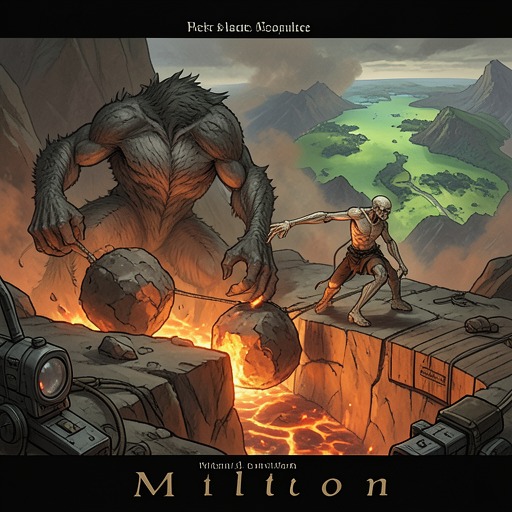
The Gates appear after Satan has crossed the desolate regions of Hell and approaches the boundary of the realm. They rise to the horrid roof of Hell in a triple construction: three folds of brass, three of iron, and three of adamantine rock. Each material intensifies the impression of permanence and resistance. Circling fire surrounds the gates without consuming them, so that the entrance is at once a fortress, a furnace, and a visible emblem of infernal power.
The Gates are not merely unattended architecture. On either side sits a formidable guardian. One shape is female from the waist upward but ends in an enormous serpent body armed with a deadly sting; Hell hounds continually bark around her middle and retreat into her womb when disturbed. The other guardian has no distinguishable limbs or stable substance, appearing as a black shadow, fierce as ten Furies, carrying a dreadful dart and wearing what resembles a kingly crown. The Gates therefore mark a border defended by bodies that are themselves violations of ordinary form.
Guardians and Authority
Sin declares that she holds the key to the infernal pit by due authority and by the command of Heaven's all-powerful King. The Gates are therefore connected to a power above the infernal beings who occupy them: they are locked under divine prohibition, and their opening is not a routine act of local administration. Death stands beside them as a force ready to oppose any living power, confident that no living might can overcome him.
This authority is nevertheless compromised by the history of Sin herself. She describes being thrust down into Tartarus and confined to a hateful office, surrounded by terrors and clamors from her own brood, which feed upon her bowels. Her position combines imprisonment with custody: she is an inhabitant of Heaven by origin, yet made the keeper of a prison in Hell. When Satan presents himself as her father and promises release, dominion, and access to a new world of light and bliss, the official barrier becomes vulnerable through lineage, grievance, and desire.
Opening of the Gates
Satan reaches the Gates on solitary flight, surveying the right and left coasts of Hell before approaching them. He does not fear the guardian shapes; apart from God and the Son of God, he values or avoids no created being. He demands passage and threatens the guardian who would resist him. Sin then recognizes Satan as the rebellious angel who first broke peace and faith in Heaven, while Satan's appeal to their shared past and to the promise of future prosperity alters the encounter from open confrontation to collaboration.
Sin takes the fatal key from her side and rolls her monstrous train toward the entrance. She raises the huge portcullis, which no infernal power except herself could move, and turns the intricate wards in the lock. Bolts and bars of massive iron and solid rock come loose with ease. The Gates recoil open with an immense, jarring sound that shakes the lowest bottom of Erebus. Their opening is thus a physical reversal of the structure's earlier meaning: what seemed absolutely impenetrable yields through the very authority intended to preserve it.
Once open, the Gates cannot be simply closed again; Sin possesses the power to open them but not to shut them. They stand wide enough for a bannered host with horses and chariots to pass through in loose array. Their mouth throws out smoke and ruddy flame like the mouth of a furnace, while the interior view reveals the secrets of the ancient deep. The threshold therefore does not disclose a stable country beyond it, but an immeasurable and dimensionless expanse in which length, breadth, height, time, and place lose their ordinary definition.
Passage into Chaos
Beyond the Gates lies Chaos, where Night and Chaos, described as the ancestors of Nature, maintain an eternal anarchy amid endless conflict. Hot, cold, moist, and dry contend for mastery, gathering embryonic atoms into rival factions. Chaos acts as an arbiter who further embroils the struggle, while Chance governs beside it. The Gates consequently open not onto a road or ordinary sea but onto the unstable womb, and perhaps grave, of nature itself.
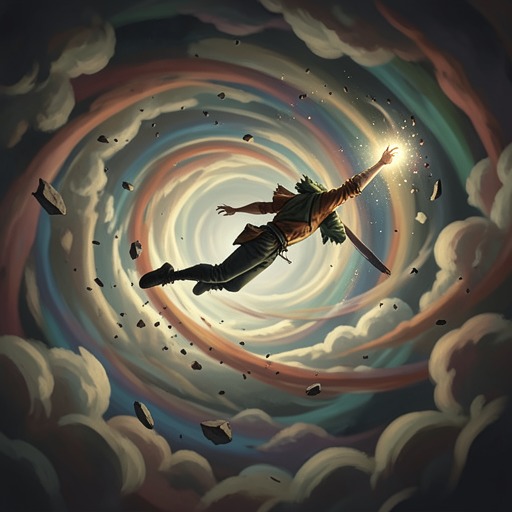
Satan stands at the brink and pauses before attempting the crossing. The distance is no narrow strait, and the surrounding noise is compared to a besieging war against a capital city or to the collapse of Heaven and the mutiny of the elements. He spreads his sail-like wings, rises through smoke, and then falls through a vast vacancy before a fiery, nitrous cloud drives him upward again. The Gates make his journey possible, but they do not make it safe: the passage converts a guarded boundary into a cosmic ordeal.
Narrative Significance
The Gates of Hell externalize the spread of rebellion. At first they enclose punishment, separating the infernal realm from the wider creation. After Satan passes through, they become an avenue by which Sin and Death can eventually pursue him toward the new world. The structure thus changes from barrier to breach, and that value shift gives the location its central narrative force.
Their design also joins political authority to bodily monstrosity and moral disorder. Brass, iron, adamant, fire, the serpent-bodied Sin, the shadow-like Death, and the limitless Chaos beyond all make the threshold a visual concentration of resistance, deformity, and instability. Yet the seemingly strongest barrier is undone through persuasion and inherited connection rather than force. The Gates embody the poem's larger irony: a realm built to contain evil opens from within, and the passage that Satan treats as a route to liberation becomes the first stage in evil's expansion into the created world.